Most recent BDB-Lab papers
BDB-Lab Links
Major Projects
Other Links
Lab Members
NGLess
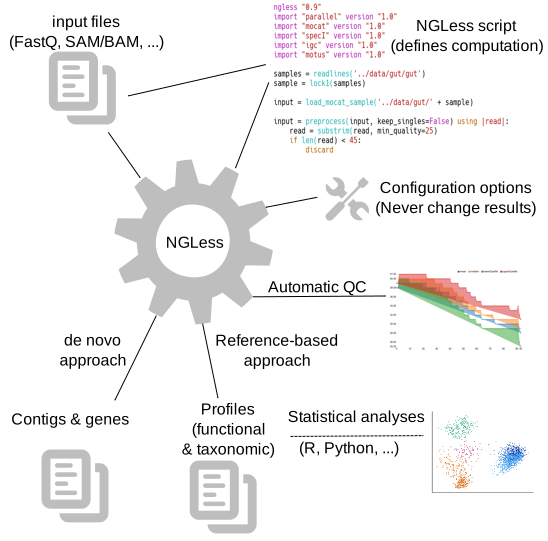
NGLess is a domain-specific language for NGS (next-generation sequencing data) processing.
By making the analysis pipeline explicit and version-controlled, NGLess aims to produce reproducible results: scripts declare the exact version of the language and of any reference databases used. NG-meta-profiler, a collection of predefined pipelines built on NGLess, provides fast taxonomic and functional profiling of metagenomes.
NGLess example
ngless "1.6"
input = fastq(['ctrl2.fq','ctrl2.fq','stim1.fq','stim2.fq'])
input = preprocess(input) using |read|:
    read = read[5:]
    read = substrim(read, min_quality=26)
    if len(read) < 31:
        discard

mapped = map(input, reference='hg19')
write(count(mapped, features=['gene']),
        ofile='gene_counts.csv',
        format={csv})
Latest release
The current version is NGLess 1.6.0 (released August 4, 2026).
Starting with this version, NGLess is written in Rust: versions up to 1.5 were written in Haskell and 1.6 replaces that implementation entirely. The motivation was to simplify building, installing, and contributing to NGLess, rather than to change what it does. NGLess 1.6 is intended as a compatible replacement for 1.5: the same scripts should produce the same results (if you hit a discrepancy, please report it — output differences are treated as bugs).
Highlights of the release:
- The HTML run report is now a single self-contained
index.htmlthat embeds its own data and makes no network requests, so it works offline on compute clusters (the 1.5 report loaded AngularJS, jQuery, Bootstrap, and d3 from CDNs). - Inline scripts (
-e/--script) no longer write a report directory by default, as a throwaway one-liner rarely wants one. Pass--create-report(or-o) to force it. Running a script from a file is unchanged. write()now writes output files atomically, so a failed run no longer leaves a half-written file behind.- Functions taking an output file check the output directory before the script runs, even when the file name is only computed at run time, so a missing output directory is reported immediately instead of after mapping or assembly has already run.
write()andcollect()supportauto_comments=[{date}], andwrite()gained the{always_3_fq_files}format flag.- Better suggestions for mistyped arguments and flags.
- When an import of a local module cannot be found, the error lists every location that was searched, and any other versions of the module available.
See the changelog for the complete list.
Upgrading from 1.5
NGLess 1.6 supports a single language version, so scripts must declare
ngless "1.6"
at the top; declaring "1.5" or older is now an error. The built-in modules
(parallel, samtools, mocat, ...) also track the version, so import them at
version "1.6"; older module versions still work, with the latest behaviour,
but print a deprecation warning.
Three previously deprecated items were removed: the strand argument to
count() (use sense, with {both}/{sense}/{antisense}; strand=True is
equivalent to sense={sense}), the --search-dir command-line flag (use
--search-path), and the --check-deprecation flag, which was never
implemented. In practice, updating the version statement is the only change most
scripts need.
Installation
NGLess is available on bioconda:
conda install -c bioconda ngless
Alternatively, pixi will install NGLess into a
self-contained, per-project environment. Create a directory with a pixi.toml
containing
[workspace]
channels = ["conda-forge", "https://conda.anaconda.org/bioconda"]
name = "ngless_env"
platforms = ["linux-64"]
version = "0.1.0"

[dependencies]
ngless = ">=1.6.0,<2"
and then run pixi install. The external tools that NGLess drives (bwa,
samtools, minimap2, megahit, prodigal) are dependencies of the conda package, so
they are installed for you in both cases.
NGLess links
- NGLess documentation
- NGLess Github repository
- NGLess manuscript: NG-meta-profiler: fast processing of metagenomes using NGLess, a domain-specific language by Luis Pedro Coelho, Renato Alves, Paulo Monteiro, Jaime Huerta-Cepas, Ana Teresa Freitas, Peer Bork in Microbiome 2019
Copyright (c) 2018–2026. Luis Pedro Coelho and other group members. All rights reserved.