BDB-Lab members involved


Storage and soil depth, in addition to wastewater treatment, govern microbiota, and mobile genetic element and antibiotic resistance markers during reclaimed water irrigation
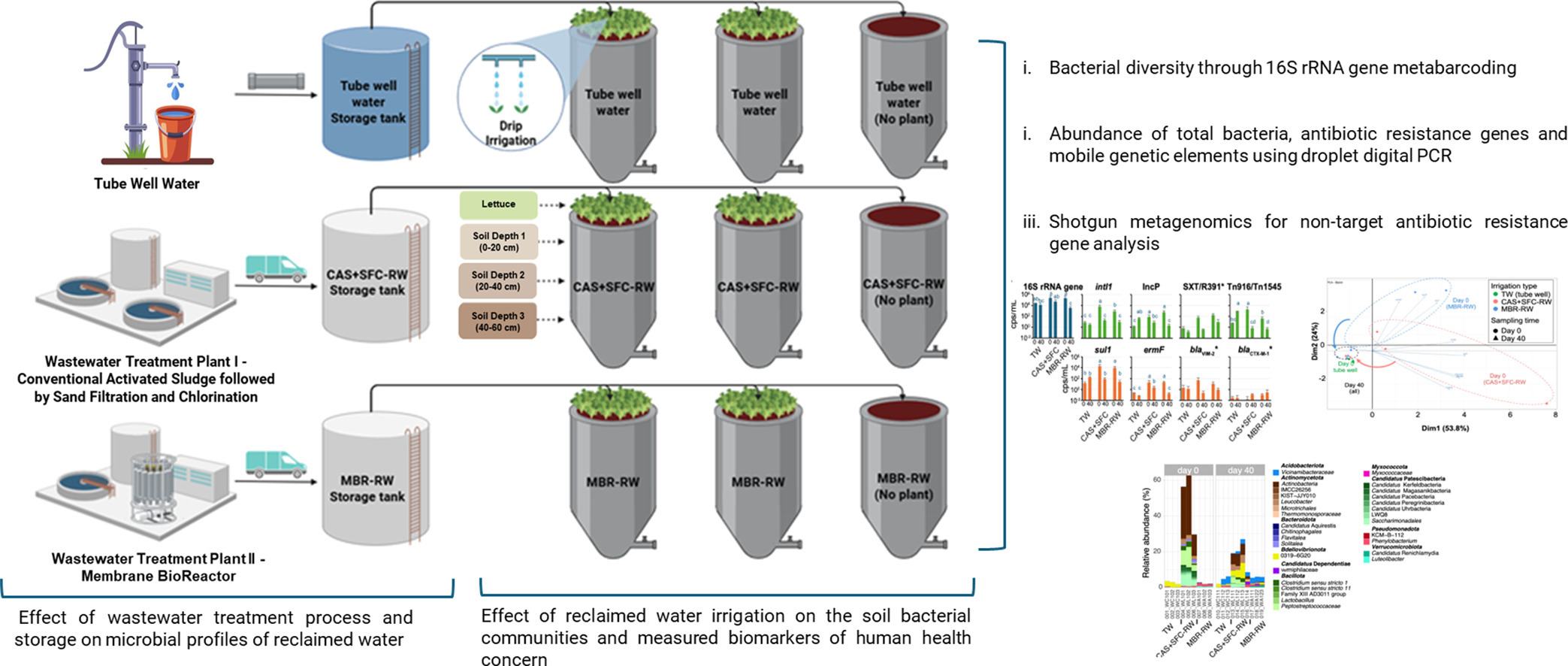
Storage and soil depth, in addition to wastewater treatment, govern microbiota, and mobile genetic element and antibiotic resistance markers during reclaimed water irrigation
by Iakovos C. Iakovides, Sotirios Vasileiadis, Anastasis Christou, Popi Karaolia, Theoni Mina, Jaqueline Rocha, Yiqian Duan, Vasiliki G. Beretsou, Nicolas Gallois, Frédérique Changey, Costas Michael, Luis Pedro Coelho, Celia M. Manaia, Christophe Merlin, Despo Fatta-Kassinos
in Water Research
Abstract
Reclaimed water (RW) offers a sustainable solution for agricultural irrigation and freshwater conservation, but its microbial and chemical composition, shaped by treatment and storage processes, requires careful consideration for environmental and public health impacts. This study compared two RW types (conventional activated sludge with sand filtration and chlorination – CAS+SFC-RW – and membrane bioreactor – MBR-RW) with a tube well (TW) water control. The goal was to assess how storage influences the microbial composition, key antibiotic resistance and mobilome genes, and RW the impact on irrigated lysimeter soils during lettuce cultivation. Total bacteria were profiled using 16S rRNA gene sequencing and ddPCR, while antibiotic resistance genes (ARGs) and mobile genetic elements (MGEs) were quantified by ddPCR and analysed by metagenomics. Initial RW samples had 1-1.5 orders of magnitude more 16S rRNA copies compared with the control, with significantly different bacterial and ARG/MGE profiles. Actinomycetota dominated CAS+SFC-RW, Bacteroidota the MBR-RW, and Pseudomonadota the TW water. Class 1 integrons and Tn916/Tn1545 were more abundant in CAS+SFC-RW compared with the MBR-RW. Storage reduced these differences toward convergence with the TW water profile, with putative pathogenic taxa, however, being more recalcitrant to change. RW irrigation altered soil bacterial composition, with MBR-RW having a greater impact as declared by the enhanced presence of Bacteroidota in the receiving soils. The RW influence was inversely related with vertical distance of the irrigation point, while the lettuce crop presence showed minimal/no impact. These results highlight the need for careful management of RW treatment and storage to ensure safe, resilient agricultural practices.
Full text: https://doi.org/10.1016/j.watres.2026.125889
Copyright (c) 2018–2026. Luis Pedro Coelho and other group members. All rights reserved.